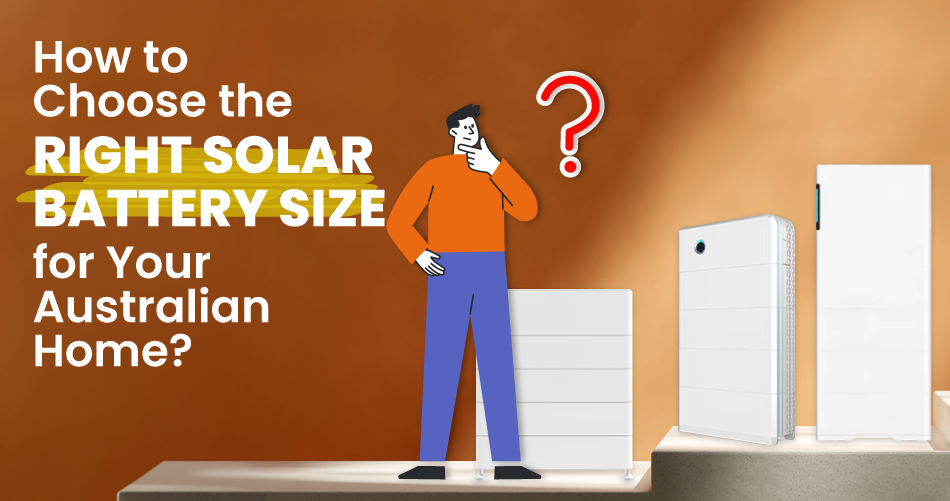
Getting your solar battery size right affects both what you pay upfront and how much it actually saves you. The biggest battery on the market isn't automatically the best fit for your roof or your bills. What matters more is how much power you use at night, how much excess solar you're generating during the day, and whether your goal is cutting your bill or having backup power in a blackout.
What Does Battery Size Actually Mean?
There are two different numbers to get your head around:
- Capacity (kWh): how much energy the battery can store
- Output (kW): how much power it can deliver at once
- Nominal capacity: the battery's rated size on paper
- Usable capacity: what you can actually draw on day to day, since batteries don't discharge to zero, and this is the number that matters most to you
Power output matters just as much as capacity. A Solar battery system with plenty of stored energy but low output can still struggle to run several appliances at the same time, so it's worth checking both figures, not just the headline kWh number.
How to Calculate the Right Solar Battery Size?
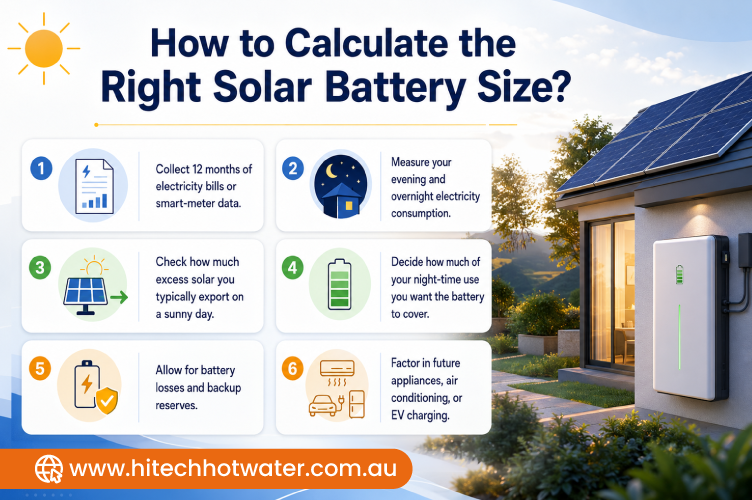
Working out your solar battery size doesn't need to be complicated. Here's a practical process:
- Collect 12 months of electricity bills or smart-meter data.
- Measure your evening and overnight electricity consumption.
- Check how much excess solar you typically export on a sunny day.
- Decide how much of your night-time use you want the battery to cover.
- Allow for battery losses and backup reserves.
- Factor in future appliances, air conditioning, or EV charging.
As a rough example, a household using 8kWh overnight, with 6kWh of daily solar export, might land on a battery in the 8–10kWh usable range. That's illustrative only, not a fit for every home, since your own numbers could easily sit higher or lower.
Solar Battery Size Chart for Australian Homes
The solar battery size chart below is a starting point, not a personalised recommendation. It's based on typical household energy profiles, so use it alongside your own bills and a proper assessment.
|
Household Profile |
Evening & Overnight Use |
Typical Excess Solar |
Indicative Usable Battery Capacity |
Possible Suitability |
|
Low-energy household |
3–5 kWh |
3–5 kWh |
7kWh Solar Battery System |
Small households, minimal evening use |
|
Average household |
6–9 kWh |
6–9 kWh |
8kWh Solar Battery System |
Most 3–4 bedroom homes |
|
High-energy household |
10–14 kWh |
8–12 kWh |
Larger families, higher daily use |
|
|
Fully electric home |
12–16 kWh |
10–14 kWh |
No gas, electric everything |
|
|
Home with pool, heat pump or EV |
14–20+ kWh |
12–18 kWh |
High and variable evening loads |
Factors That Can Change the Battery Capacity You Need
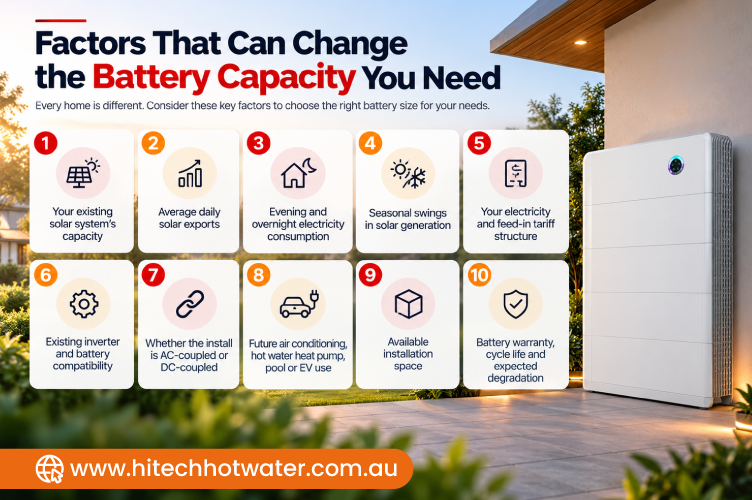
A few things can shift your ideal size up or down:
- Your existing solar system's capacity
- Average daily solar exports
- Evening and overnight electricity consumption
- Seasonal swings in solar generation
- Your electricity and feed-in tariff structure
- Existing inverter and battery compatibility
- Whether the install is AC-coupled or DC-coupled
- Future air conditioning, hot water heat pump, pool or EV use
- Available installation space
- Battery warranty, cycle life and expected degradation
In short, solar battery size isn't a one-off calculation, and it's worth revisiting whenever your household's electricity use changes.
Choose the Battery Around Your Main Goal
The right solar battery size for home use really depends on what you're trying to achieve:
- Reducing electricity bought from the grid: generally, needs less capacity
- Storing excess daytime solar: sized around your typical daily export
- Running essential appliances during a blackout: needs enough output, not just capacity
- Whole-home backup: the biggest capacity requirement of the lot
- Increasing energy independence: a bigger, more deliberate sizing decision
- Joining a Virtual Power Plant: may come with its own minimum size or VPP-readiness requirements
Worth remembering: how long backup power lasts depends on both your stored capacity and how much your appliances are drawing at the time.
Battery Cost, Incentives and Long-Term Value
Look at the installed price, not just the battery's sticker price. A few things to check before comparing quotes:
- Installed price, including all the extras below, not just the battery itself
- Cost per usable kWh, a more useful comparison than headline battery price
- Hybrid inverter or battery inverter requirements
- Backup gateway and essential-load circuits
- Any switchboard or electrical upgrades needed
- Warranty period and warranted energy throughput
- Available federal and state incentives
Federal battery STC eligibility applies to qualifying batteries with nominal capacities from 5kWh to 100kWh, but certificates are calculated only on the first 50kWh of usable capacity. The incentive tapers across the 14kWh, 28kWh and 50kWh capacity bands, so bigger isn't automatically better value per kWh. Choosing a bigger battery just to chase a larger incentive isn't a sound reason on its own, so weigh it against what you'll actually use.
Common Battery-Sizing Mistakes to Avoid
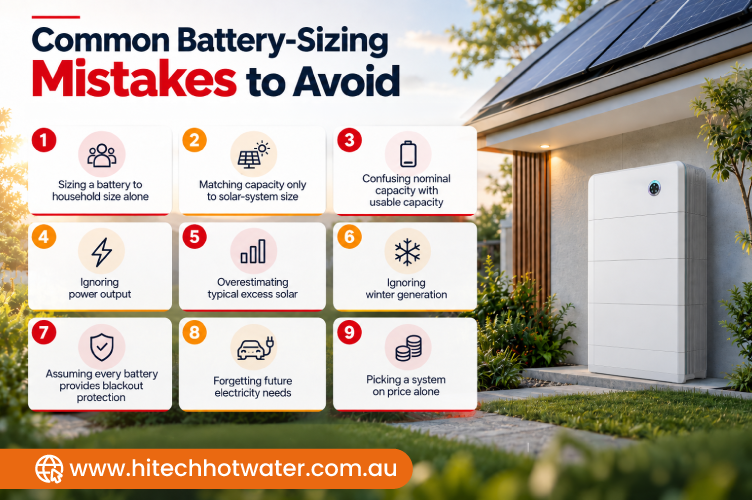
A few mistakes come up again and again:
- Sizing a battery to household size alone
- Matching capacity only to solar-system size
- Confusing nominal capacity with usable capacity
- Ignoring power output
- Overestimating typical excess solar
- Ignoring winter generation
- Assuming every battery provides blackout protection
- Forgetting future electricity needs
- Picking a system on price alone
Most of these come back to the same root cause: guessing solar battery size instead of working from real household data.
Why Choose HiTech Hot Water for Your Solar Battery?
HiTech Hot Water sizes every solar battery system around your household's real power usage, reviewing your bills or smart-meter data and checking compatibility with your existing solar and inverter. You get battery recommendations for savings or backup, itemised pricing, incentive assistance, coordinated installation, and warranty-backed support.

Conclusion:
Getting your solar battery size for home right means matching evening usage, excess solar, usable capacity, backup needs, and future demand. Request a personalised battery assessment and itemised quote from HiTech Hot Water.
FAQs
Match usable capacity to the electricity your home uses from late afternoon to morning. Then check whether your daily surplus solar can recharge it. Twelve months of smart-meter data provides the clearest estimate.
A 10kWh battery may suit a household with moderate evening use, but it is not automatically right for everyone. Compare its usable capacity with your overnight consumption, large appliances, and backup expectations.
There is no fixed battery capacity for a 6.6kW solar system. Size it by comparing typical solar exports with evening and overnight consumption, seasonal generation, and expected future electricity use.
Yes, an oversized battery may not charge fully or discharge enough each day to justify its cost. Larger capacity may still suit high consumption, extended backup or future electrification plans.
For bill savings, match capacity to regular evening usage. For backup, calculate essential appliance demand, desired outage duration, battery reserve, and the inverter’s continuous and surge power ratings.