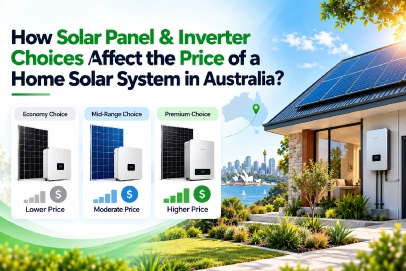
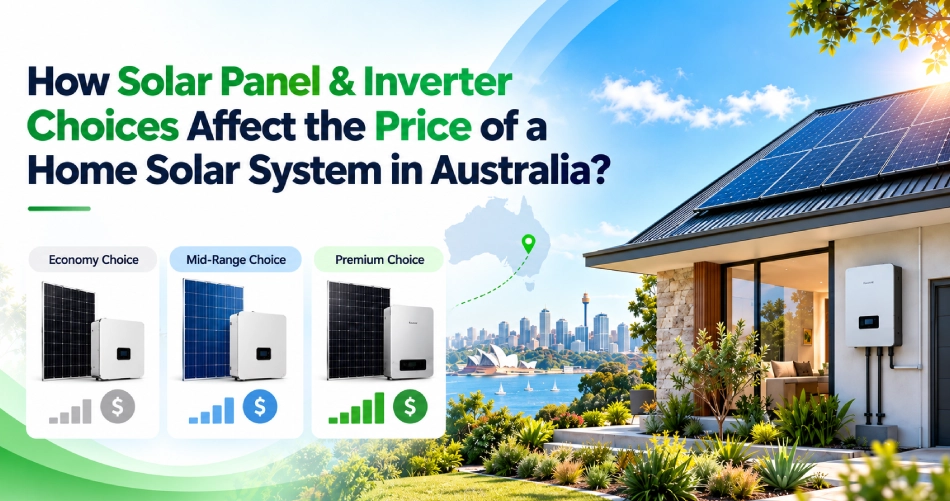
Two solar systems advertised with the same kW capacity can still land at very different prices once you compare quotes. Panels and inverters are two of the biggest cost factors behind that gap. The solar system price Australia homeowners actually get quoted also depends on their roof, their property, and what the installation itself involves.
What Changes a Solar System Price for Home Installations?

A solar system price for home installations moves with a handful of factors:
- Panel efficiency, wattage and product quality
- Inverter design and capacity
- Monitoring and battery-ready features
- Roof access and installation complexity
- Warranty coverage and installer support
The cheapest panels and inverters on the market aren't always the better long-term buy, sometimes paying a bit more upfront saves money over the life of the system.
How Panel Choices Affect the Solar Panel Price in Australia?
Panel Efficiency and Wattage
Higher-wattage or more efficient panels generally cost more per panel. They tend to suit homes with limited usable roof space, since you can hit the same system capacity with fewer panels. On a roof with plenty of room, standard-efficiency panels can still make more financial sense.
Product Quality and Warranty
A few things worth comparing between panel brands:
- Product and performance warranties
- Expected degradation over the panel's lifetime
- How well the panel performs in hot weather
- Manufacturer support available in Australia
- Whether replacement panels are actually available if something fails down the track
The solar panel price in Australia varies a fair bit between brands, and a premium price tag doesn't automatically mean a better return for every household, it depends on your roof and how long you plan to stay in the home.
How Inverter Choice Affects the Final Price?
Types of Solar Inverters
There are three main types of solar inverters you'll come across:
- String inverters: one central unit connecting to a string of panels
- Microinverters: a small inverter fitted to each individual panel
- Hybrid inverters: built to work with solar panels and a battery together
Capacity, Monitoring and Battery Compatibility
A few things affect the solar inverter price Australia installers quote you:
- Inverter capacity
- Single-phase or three-phase compatibility
- Panel-level monitoring
- Shading-management features
- Battery compatibility
- Backup capability during a blackout
- Product warranty and local support
The right inverter really depends on your property, how the system is designed, and what your future energy plans look like, there's no single best option for every home.
Panel and Inverter Cost Comparison
Here's how panel and inverter choices tend to affect solar panel price in Australia, the types of solar inverters available, and solar inverter price Australia quotes, side by side:
|
Component Choice |
Usual Upfront Price Effect |
May Suit |
Main Consideration |
|
Standard-efficiency panels |
Lower to moderate |
Homes with sufficient roof space |
More panels may be required |
|
High-efficiency panels |
Generally higher |
Limited roof space |
Higher output per panel |
|
String inverter |
Generally lower |
Simple, unshaded roofs |
Centralised system design |
|
Microinverters |
Generally higher |
Complex or partly shaded roofs |
Panel-level operation |
|
Hybrid inverter |
Higher initial cost |
Future battery plans |
Compatibility must be checked |
Costs Beyond the Panels and Inverter
The solar system price Australia homeowners end up paying isn't just panels and an inverter. Other things that can move the price include:
- Roof type, pitch and access
- Switchboard upgrades
- Scaffolding or specialised mounting
- Cable runs and meter work
- Local network requirements
- Property location
- Installation workmanship
A properly designed Residential Solar System quote should clearly identify equipment, installation work, exclusions and potential additional costs, rather than leaving you to guess what's included.
How to Compare Solar Quotes Properly?
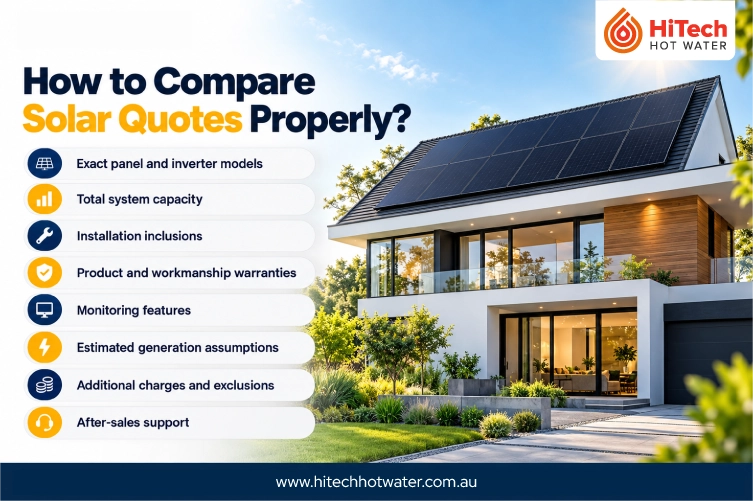
Before accepting a quote, compare:
- Exact panel and inverter models
- Total system capacity
- Installation inclusions
- Product and workmanship warranties
- Monitoring features
- Estimated generation assumptions
- Additional charges and exclusions
- After-sales support
A solar system price for home use is only one part of the picture, comparing overall value across these points tells you a lot more than chasing the lowest number on the page.
Why Choose HiTech Hot Water?
HiTech Hot Water can assess your household's electricity usage, roof conditions and future battery plans before recommending suitable panels and inverter options for your property. We won't claim to be Australia's best or promise a guaranteed bill saving, what we can do is help you compare your options properly.

Conclusion
Panel and inverter choices can genuinely shift the solar system price for home installations up or down. Request a property-specific quote to see what fits your home.
FAQs
No, the best choice depends on efficiency, available roof space, warranty coverage, manufacturer support and your household's energy needs.
A hybrid inverter may justify the extra cost if you plan to add a compatible solar battery later.
Yes, microinverters usually cost more because they require additional equipment and installation, while offering panel-level monitoring and design flexibility.
Quotes can differ because of component quality, installation inclusions, warranties, roof conditions, electrical work and ongoing customer support.
Higher-efficiency panels generally cost more, but they can deliver greater capacity where suitable roof space is limited.
No, they must be technically compatible, correctly sized, and supported by suitable product, performance, and installation warranties.