A 10kW solar system Australia wide is one of the bigger residential setups you can buy, usually 20-plus panels paired with a three-phase inverter. It suits larger households with high daytime power use, not the average small home.
Costs, output and roof space all scale up with it, and a battery is optional rather than automatic. Whether it's right for you comes down to how much power your household actually uses, and what your roof can handle.
Is a 10kW Solar System Right for Your Home?
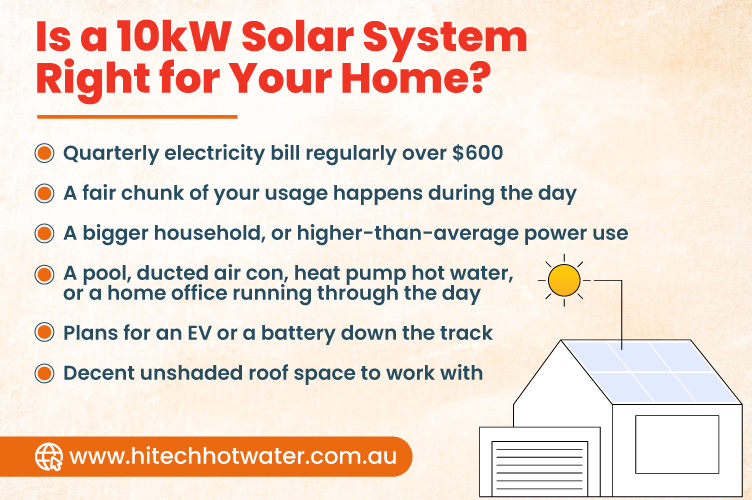
A 10kW system tends to make sense once your household hits a few of these markers:
- Quarterly electricity bill regularly over $600
- A fair chunk of your usage happens during the day
- A bigger household, or higher-than-average power use
- A pool, ducted air con, heat pump hot water, or a home office running through the day
- Plans for an EV or a battery down the track
- Decent unshaded roof space to work with
It's also worth checking your local network export limits before you commit, since some areas cap how much solar you can send back to the grid.
How Many Panels and How Much Roof Space Will You Need?
Most 10kW solar panels setups land somewhere between 22 and 25 panels, depending on the wattage you choose:
- Panel count: roughly 22–25 panels for a 10kW array, fewer if you go with higher-wattage panels (say 440W instead of 400W)
- Panel size: around 1.7m x 1.1m each, so it's usable roof area that counts, not total roof size
- Roof factors: direction, pitch, shading and installation setbacks all affect the final layout
- Capacity note: panel capacity and inverter capacity aren't the same number, so don't assume one from the other
A proper roof assessment from an installer is worth doing before you settle on a final size.
10kW Solar System Performance Across Australia
10kW solar system Performance varies a fair bit depending on where you live. As a rough guide, this size of system generates somewhere between 35 and 45 kWh a day, though that swings with the season, your postcode, and how the array is set up.
A Brisbane roof and a Hobart roof won't produce the same numbers even with identical 10kW solar panels installed. Rather than quoting one national figure, it's worth running your address through a postcode-based tool like SunSPOT to get a realistic estimate for where you live.
What Affects 10kW Solar System Efficiency?
10kW solar system efficiency comes down to a few factors working in concert:
- Roof pitch and panel direction
- Partial shade from trees or adjacent buildings
- Losses in inverter and wiring
- How hot the panels get in summer
- Year after year gradual panel degradation
Also, it is worth remembering that kW is the capacity of the system, whereas kWh is what it actually produces. 10kW solar system efficiency is really about closing the gap between those two numbers.
10kW Solar System Cost in Australia
10kW solar system cost in Australia typically sits between $7,500 and $12,000 after the federal STC rebate, and where you live makes a real difference.
Australia is split into STC zones based on sunshine hours, so QLD and WA homes generally attract a bigger rebate than NSW or SA, which flows through to a lower final price.
|
State |
Estimated 10kW Solar System Price (after federal STC rebate) |
Notes |
|
NSW |
$8,000* – $11,500* |
No additional state solar rebate; STC value only |
|
QLD |
$7,500* – $10,500* |
Higher STC zone in most areas; typically, the cheapest post-rebate price |
|
WA |
$7,500* – $10,500* |
Higher STC zone; strong solar resource lowers per-watt cost |
|
SA |
$8,500* – $12,000* |
High electricity prices help payback, though install pricing runs a bit higher |
Figures are indicative of market ranges, not a quote. Panel and inverter brand, roof type and height, switchboard upgrades, smart-meter or network application fees, and warranty tier all move the final number, and remove an old system if you're upgrading adds to it too. Advertised prices don't always include everything your specific roof will need, so ask for an itemised quote before you sign.
10kW Solar System with Battery Price and Considerations
Adding solar battery in existing system Changes the picture. What matters more than a battery's nominal capacity is its usable capacity, and whether it can run essential circuits during a blackout. Under the federal Cheaper Home Batteries Program, eligible households currently get a rebate applied straight off the price by their installer, though the rebate rate steps down over time, so check the current figure before you sign anything.
A bigger solar array doesn't automatically mean you need a bigger battery. It comes down to how much power your household uses of an evening. As a general guide, here's how battery size tends to match up with a 10kW solar system, and how the combined price looks state by state after current rebates:
|
State |
Suggested Battery Size for 10kW Solar |
Estimated 10kW Solar + Battery Price (after rebates) |
State-specific notes |
|
NSW |
10–14 kWh for evening-heavy households |
$16,000* – $22,000* |
NSW no longer offers a standalone battery rebate, but the VPP incentive can add extra value if you join a virtual power plant |
|
QLD |
10 kWh for most homes; 14kWh+ if running a pool or ducted AC of an evening |
$15,500* – $21,500* |
Cheaper solar side of the equation due to STC zone; no separate state battery rebate currently |
|
WA |
10 kWh, capped for state rebate purposes |
$14,500* – $20,500* |
Synergy and Horizon customers can access an additional per-kWh state rebate on top of the federal discount, worth confirming with your retailer |
|
SA |
10–14 kWh, especially for households on time-of-use tariffs |
$16,500* – $22,500* |
High SA electricity prices mean battery payback tends to be faster here than in most other states |
These are indicative combined-system ranges only. Actual pricing depends on the battery brand, hybrid inverter compatibility, installation complexity, and how many usable kWh your household genuinely needs of an evening.
The Cheaper Home Batteries Program rebate is not means-tested, but the per-kWh rate changes over time, so confirm the current rate with your installer before signing.
Potential Savings and Payback Period
Savings depend on how much solar you use directly in the home versus what you export for a feed-in tariff, plus your retail electricity rate. Households with high daytime use, or a battery charging up for the evening, tend to see faster payback.
System price and any ongoing costs factor in too. Because usage patterns and tariffs differ so much between households, there's no fixed payback period that applies to everyone, and it's worth being wary of any quote that promises one.
What to Check Before Accepting Any Solar Quote?
Before signing off on 10kW solar panels for your roof, run through this checklist:
- Itemized price, not a single lump sum
- Exact panel and inverter models named, not just brand names
- Products confirmed on the approved product list
- Installer is Solar Accreditation Australia-accredited
- Proposed panel layout shown to you before installation
- Expected annual generation figure included
- Network approval and export limit confirmed for your address
- Product, performance and workmanship warranties spelled out
- A monitoring system included
- Genuine local after-sales support, not just a call center

Why Choose HiTech Hot Water?
HiTech Hot Water helps Australian homeowners choose a 10kW solar system based on their energy use, roof space, performance needs and future battery plans. With the right equipment, clear advice and support throughout the process, you can make a confident decision for reliable solar system & savings in the long term.
FAQs
Under good conditions, a 10kW system may generate roughly 35–45kWh daily as an annual average. Actual output varies with postcode, season, roof direction, shading, temperature and system losses.
Most 10kW systems require around 22–25 panels when individual panels are rated between 400W and 460W. The final number depends on the selected panel wattage and system design.
A 10kW system commonly needs approximately 45–55 square metres of usable roof space. The exact requirement depends on panel dimensions, roof shape, orientation, obstructions and installation clearances.
Not always. This depends on the inverter capacity, existing property connection, local network requirements, and export limits. Your solar installer should confirm the connection requirements before preparing the quote.
The installed price varies with equipment quality, roof complexity, electrical upgrades, location, and available STCs. Compare itemised quotes showing the original price, incentive discount and final out-of-pocket cost.
A battery may be worthwhile if you export substantial daytime solar and purchase significant electricity at night. Battery capacity should be based on usage data, tariffs, budget and backup requirements.