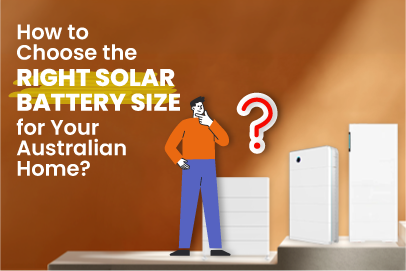
For years a home battery was the thing people wanted but talked themselves out of. Too dear. Payback too far off. The Cheaper Home Battery Program has shifted that. It's a federal rebate worth about 30% off the upfront cost of a battery.
No income test. And you can still take whatever your state throws in on top. Got solar on the roof, or get it soon? Then it's worth reading this before you ring anyone for a quote. Below: what it is, who gets it, what it might save you, and how you actually go about it.
Understanding the Cheaper Home Battery Program
Basically, the government got sick of watching rooftop solar go to waste. Homes make heaps of power in the daytime, sell it back to the grid for a few cents, then buy it again after dark for ten times the price. A battery stops that. Trouble is batteries cost a fair bit, so they built a discount around the same certificate scheme (STCs) that's been on solar panels for ages.
No forms. No cheque in the post three months later. Your installer works out how many certificates your battery's worth, cashes them in, and takes that straight off the quote. You pay less. Done.
Why's everyone suddenly interested? Bills keep going up; feed-in tariffs keep going down, and the gap between the two just gets wider. Remember, this is the federal one. Your state might run its own battery rebate as well, and plenty of people end up using both.
Who Can Get the Federal Home Battery Rebate?
Honestly, the rules are looser than most folks think. No income cap. No particular kind of house. You don't even need panels already, though it obviously helps.
You'll generally qualify if you:
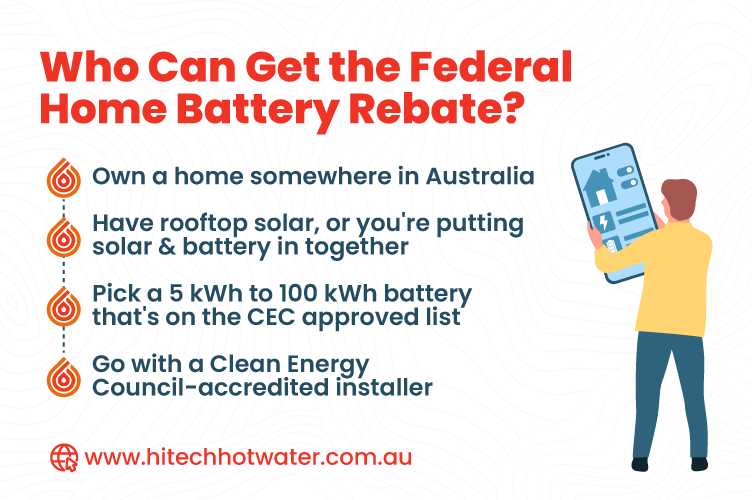
- Own a home somewhere in Australia
- Have rooftop solar, or you're putting solar & battery in together
- Pick a 5 kWh to 100 kWh battery that's on the CEC approved list
- Go with a Clean Energy Council-accredited installer
The ones who miss out usually pick up a battery that isn't on the approved list, went for a grid-only battery with no solar attached (it has to pair with solar), or used a sparky who isn't accredited. Get those three rights and you're almost certainly fine. Your postcode and your pay slip don't come into it.
How Much Can You Save With the Home Battery Rebate?
I'll be straight with you: I'm not putting a dollar figure here. The rate shifts, and whatever I write today is likely wrong by the time you read it. What actually moves your number is a mix of things. Battery size does most of the work, since the rebate runs per usable kWh, and the newer tiered setup means those first kilowatt-hours count for more than the last ones.
The install adds up too, depending on switchboard work and how easy the spot is to reach. Brand changes the sticker price before any discount lands. A state incentive stacked on top can shift things a lot. And your own power habits decide whether a big system pays off or just sits half-empty.
Rough shape of it:
|
Without the rebate |
With the rebate |
|
Bigger cost up front |
Smaller install cost |
|
Payback drags on |
Money comes back quicker |
|
A "one day" purchase |
Doable right now |
Get a real quote before you build your budget around any number off the internet. This blog included.
How to Apply for the Cheaper Home Battery Program?
There's no government form, which throws people. It all runs through your installer. You check you're eligible first, which mostly means solar on the roof (or planned) and a grid connection.
Then you settle on a battery size that fits how much power your place chews through, not just the biggest one on the list. Grab two quotes from accredited installers so you've got something to compare. Your installer sorts the compliance and the STC paperwork once you've picked. And the rebate turns up as a smaller figure on the invoice before the job even starts. That last bit catches people out. You're not chasing money back later. It's already knocked off what you pay.
Is a Home Battery Worth It Even with the Rebate?
Fair question. Even with the rebate chipping in, you're still forking real money, so it's worth asking.
For most homes pulling decent daytime solar, the answer is yes. Mostly you quit buying pricey grid power of an evening, which is when the bill usually stings. You lean on the grid less. Wire it right and you've got backup when the power drops out. Spare solar that used to go out for next to nothing that gets used at your place instead. And these things last a while. Ten, fifteen years for most, so the saving keeps ticking over.
It's not a sure thing for everyone, mind you. Low daytime use, or a roof that doesn't throw off much spare, and the maths gets dull fast. Loads of people googling home battery incentives 2026 are chewing on exactly that. Does it stack up for my house, specifically, not just does the rebate exist.

Conclusion
The rebate knocks a proper chunk off a battery. Whether it's worth it for you, though, comes down to your solar, how you use power, and what you end up buying. That stuff matters as much as the discount does. Want a straight answer on the cost and the savings for your own place? Get a quote from an accredited team and take it from there.
FAQs
The Cheaper Home Battery Program is a federal battery incentive that helps eligible Australian households reduce the upfront cost of installing an eligible home battery system.
Eligibility generally requires an Australian home, an eligible battery between 5 kWh and 100 kWh, rooftop solar or a solar-and-battery installation, and an appropriately accredited installer.
No. According to the information covered in this guide, you can install solar and a battery together. However, the battery needs to be paired with a solar system to qualify.
The rebate is handled through the installer rather than being paid to you later. The installer calculates the applicable certificates and applies the resulting discount directly to the battery installation price.
The guide states that eligible batteries are generally between 5 kWh and 100 kWh, subject to the applicable program requirements and approved product list.
Potentially, yes. The blog explains that your state may offer its own battery incentive, which can sometimes be combined with the federal program. State-specific eligibility and rules should be checked before installation.