If your air conditioner runs all day but still struggles to cool your home, or your energy bills keep climbing, there’s a high chance you’ve got the wrong system size.
Choosing the correct air conditioner size for home isn’t just a technical detail. It directly affects comfort, running costs, and how long your system lasts. This matters even more in Australia, where climate varies widely. QLD homes deal with heavy cooling loads, NSW sees mixed conditions, and VIC often requires more moderate cooling.
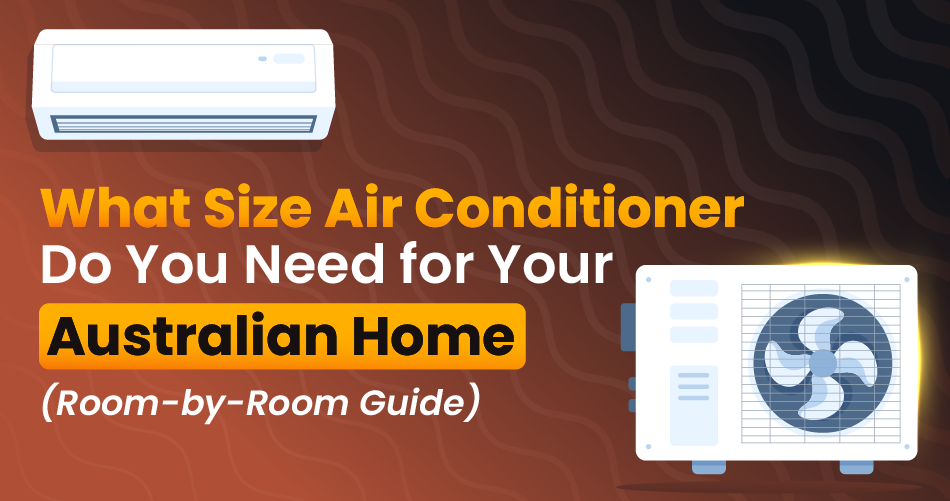
This air conditioner size guide breaks it down room by room so you can stop guessing and choose the right system the first time.
Quick Answer: What Air Conditioner Size Do I Need?
If you’re looking for a fast answer to what air conditioner size do I need, here’s a general rule:
- Small room (up to 20 m²) → 2.0 to 2.5 kW
- Medium room (20–40 m²) → 2.5 to 5.0 kW
- Large room (40–60 m²) → 5.0 to 7.5 kW
This is a general air conditioner size guide. The exact size depends on ceiling height, insulation, and how much heat the room gains from sunlight or appliances.
Why AC Size Matters
Getting the wrong air conditioner size for room creates problems immediately.
An undersized system will:
- Run constantly
- Struggle to reach the set temperature
- Drive up electricity bills
An oversized system will:
- Cost more upfront
- Cycle on and off too quickly
- Leave humidity in the air
Correct sizing improves comfort, reduces running costs, and extends system lifespan. That’s why any serious aircon guide starts with sizing, not brand or price.
How Air Conditioner Size is Measured
Air conditioners in Australia are measured in kilowatts (kW), which represent cooling capacity.
Think of kW as cooling power. The higher the number, the more heat the system can remove from a space.
A proper air-conditioner size guide focuses on matching kW output to room size and heat load, not just square metres alone.
Room-by-Room Air Conditioner Size Guide
1. Air Conditioner Size for Bedroom
For a typical air conditioner size for bedroom, most homes require:
- Small bedroom → 2.0 to 2.5 kW
- Master bedroom → 2.5 to 3.5 kW
Factors that change sizing:
- Direct sunlight exposure
- Window size
- Insulation quality
For bedrooms, quiet operation matters. Don’t just focus on size. Choose a system designed for low noise.
2. Air Conditioner Size for Living Room
Living rooms usually need higher capacity due to space and usage.
Typical air conditioner size for room in living areas:
- Medium living room → 3.5 to 5.0 kW
- Large open-plan area → 5.0 to 7.5 kW
Open layouts, large windows, and multiple occupants increase cooling demand. This is where many homeowners underestimate their required air-conditioner size for home.
3. Air Conditioner Size for Kitchen
Kitchens generate additional heat from cooking appliances.
Recommended approach:
- Base size for room
- Add 0.5 to 1.0 kW
Without this adjustment, your system will struggle during peak usage.
4. Air Conditioner Size for Whole Home
For full-home cooling, you’ll need to decide between split systems and ducted systems.
A general air conditioner size for home calculation uses:
- Roughly 0.12 to 0.15 kW per square metre
Ducted systems are better suited for consistent, whole-home cooling, especially in larger Australian homes.
Typical Air Conditioner Pricing by Room Type
While final costs vary depending on installation requirements, property layout, and system selection, the following provides a general pricing guide:
|
Room Type |
Recommended Size |
Typical Installed Price* |
|
Bedroom |
2.5–3.5 kW |
From ~$2,350 |
|
Living Room |
5–6 kW |
From ~$2,491 |
|
Open-Plan Living Area |
7+ kW |
From ~$2,599 |
*Indicative pricing only. Actual installation costs may vary depending on the property, electrical requirements, and selected system.
Air Conditioner Size Calculation Formula
Here’s a simple way to calculate:
Room size (m²) × 0.125 = Required kW
Example:
A 30 m² room:
30 × 0.125 = 3.75 kW → Choose a 3.5 to 4.0 kW system
Quick Reference Table:
|
Room Size |
Recommended kW |
|
10–20 m² |
2.0–2.5 kW |
|
20–30 m² |
2.5–3.5 kW |
|
30–40 m² |
3.5–5.0 kW |
|
40–60 m² |
5.0–7.5 kW |
Adjust your air conditioner size guide calculation if:
- Ceilings are higher than standard
- Insulation is poor
- The room gets heavy sunlight
- More people regularly use the space
Factors That Affect AC Size
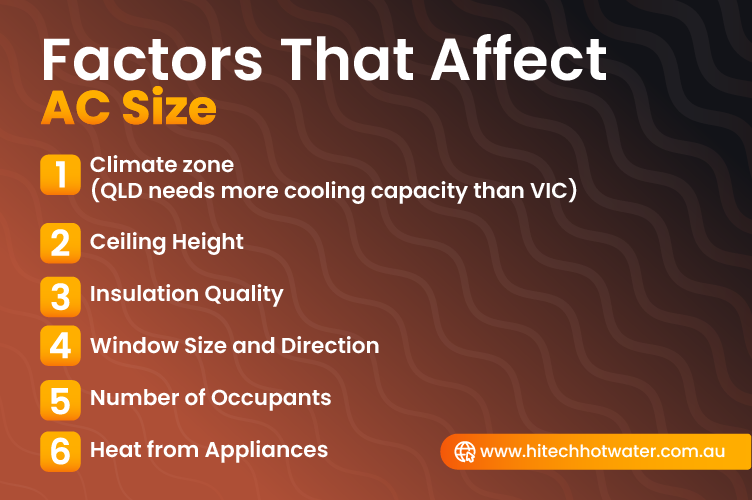
Even the best air-conditioner size guide fails if you ignore real-world conditions.
Key factors:
- Climate zone (QLD needs more cooling capacity than VIC)
- Ceiling height
- Insulation quality
- Window size and direction
- Number of occupants
- Heat from appliances
This is why two identical-sized rooms can require completely different systems.
Split System vs Ducted: Which Size Do You Need?
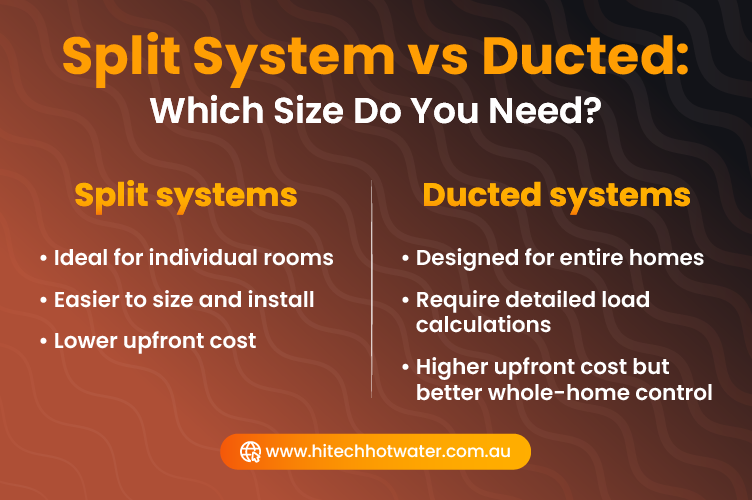
Split systems:
- Ideal for individual rooms
- Easier to size and install
- Lower upfront cost
Ducted systems:
- Designed for entire homes
- Require detailed load calculations
- Higher upfront cost but better whole-home control
If you’re planning to buy air conditioner systems for multiple rooms, ducted may offer better long-term value, but only if sized correctly.
Common Mistakes to Avoid
Most sizing mistakes are predictable:
- Guessing instead of calculating
- Choosing based on price alone
- Ignoring insulation and sunlight
- Installing oversized systems
If you’re still asking what air conditioner size do I need, it usually means you haven’t done a proper load calculation yet.
Energy Efficiency & Cost Savings
Correct sizing is one of the biggest drivers of efficiency.
A properly sized system:
- Uses less electricity
- Maintains stable temperatures
- Reduces wear and tear
Look for Australian energy rating labels when comparing systems. The right air conditioner size for room combined with a high-efficiency unit delivers real savings.
Air Conditioner Incentives & Rebates in Australia
Australia offers various incentives for energy-efficient upgrades, including air conditioning systems.
These programs vary by state, particularly in VIC and NSW, but the benefits are consistent:
- Lower upfront installation cost
- Faster return on investment
- Encouragement to upgrade to energy-efficient systems
If you’re upgrading, it’s worth checking current rebates before you commit.
Expert Tip
No online air-conditioner size guide replaces a professional assessment.
A proper load calculation considers insulation, orientation, airflow, and usage patterns. This is where most DIY estimates fall short.
At HiTech Hot Water, systems are sized based on real conditions, not guesswork. That’s the difference between a system that works and one that wastes money.
Not Sure What Size You Need?
If you’re still unsure what air conditioner size do I need, don’t guess.
Get expert advice based on your home layout, usage, and climate conditions. The right system size will save you money every year, not just on installation day.

Conclusion
Choosing the right size isn’t optional. It’s the foundation of performance.
The right air conditioner size for home means:
- Better comfort
- Lower energy bills
- Longer system life
Use this air conditioner size guide before you make a decision. Because once it’s installed, fixing the wrong size costs more than getting it right the first time.
Frequently Asked Questions (FAQs)
For a typical 3-bedroom house in Australia, you’ll usually need a ducted system between 10 kW to 18 kW, depending on home size, insulation, and climate zone. Alternatively, multiple split systems can be used for individual rooms.
To calculate the correct size, use this formula: Room size (m²) × 0.125 = required kW
For example:
A 30 m² living room → 30 × 0.125 = 3.75 kW. You would typically choose a 3.5 to 5.0 kW system, depending on sunlight and insulation.
For a 60 m² open-plan space, you’ll generally need a 5.0 to 7.5 kW air conditioner. If the space has large windows or heavy sun exposure, consider going toward the higher end of the range.
For a 20 m² room, a 2.5 kW split system is usually ideal. If the room gets a lot of sunlight or has poor insulation, you may need closer to 3.0 kW.
For small apartments:
- Studio or 1-bedroom → 0 to 3.5 kW
- Small 2-bedroom → 5 to 5.0 kW
Split systems are typically the most efficient and cost-effective option.
For a 50 m² area, you’ll need approximately 5.0 to 7.0 kW. Open layouts or high ceilings may require a larger system.
A 12x12 ft room (~13 m²) typically requires a 2.0 to 2.5 kW air conditioner, which is suitable for small bedrooms or home offices.
A 16x16 ft room (~24 m²) generally needs a 2.5 to 3.5 kW system. Adjust based on sunlight, ceiling height, and insulation.